Blog 1: US Domestic Manufacturing
Inflation Reduction ACT (IRA)
TAX Credits - Domestic Content
Inverter Strategies
IRA Domestic Content Threshold
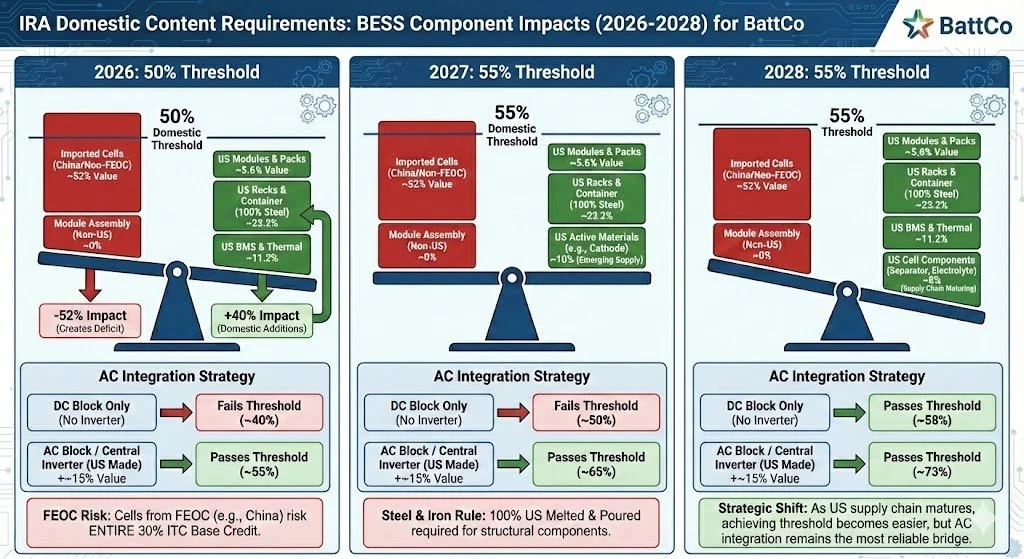
The graphic illustrates the challenge and strategy for BattCo to meet the 50% Domestic Content Threshold required in 2026 for the Inflation Reduction Act (IRA) tax credits.
Since you are considering importing battery cells from China or other non-FEOC sources, the graphic highlights how "The Cell Gap" (the large orange and red blocks) makes it mathematically difficult to reach the required percentage without including the inverter and other AC components in the calculation.
1. The "DC Block Only" Scenario
When manufacturing a standalone DC Block (Battery modules + Enclosure), the battery cells dominate the cost structure.
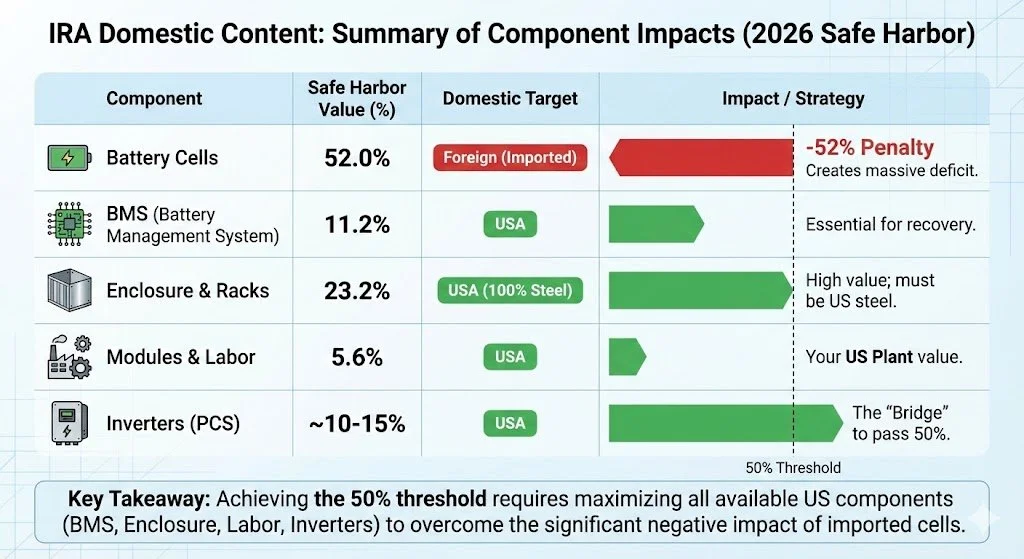
The Cell Gap (~52%): In the IRS Safe Harbor tables (Notice 2025-08), cells are assigned a value of 52%. If these are imported, you start with a 0% credit on over half of the system's value.
Domestic Components: Even if you manufacture everything else in the U.S.:
Enclosure & Racks (~23.2%): These must be 100% U.S. "Melted and Poured" steel.
BMS (~11.2%): Sourcing a U.S.-made Battery Management System is a major contributor.
Modules, Packs & Labor (~5.6%): The "Substantial Transformation" labor at your US plant.
Thermal Management (~5.6%): U.S.-sourced pumps, chillers, and piping.
Result (~45.6%): As shown by the red arrow, a DC Block with imported cells typically fails to reach the 50% threshold required for the 10% bonus.
2. The "Inverter Bridge" Strategies
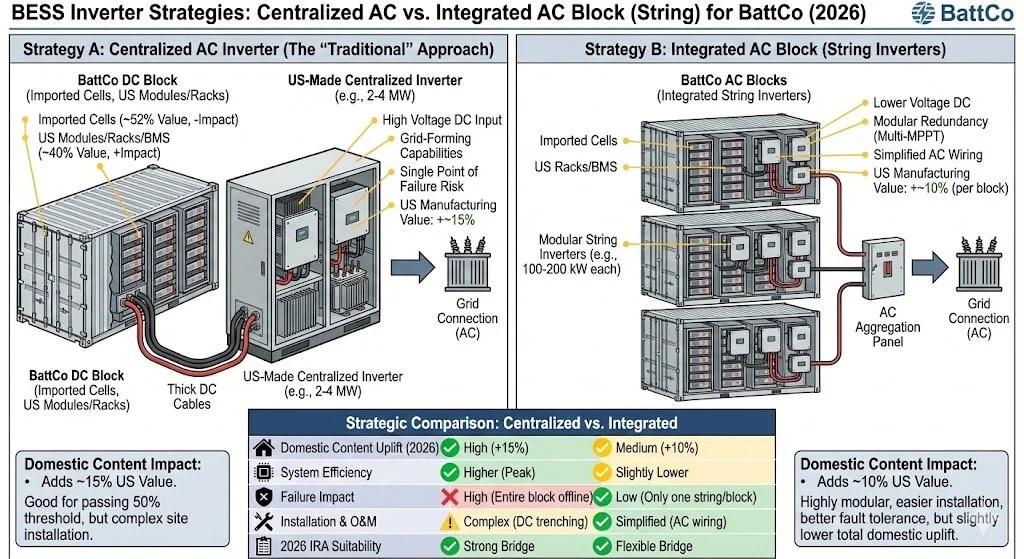
To pass the threshold, you must "dilute" the cell cost by including more U.S.-made components in the total "Defined Project" calculation.
Scenario A: Centralized AC Inverter (+15% Value): By including a separate, U.S.-manufactured central inverter, your total domestic percentage rises to ~60.6%, safely passing the threshold.
Scenario B: Integrated AC Block (+10% Value): Integrating string inverters directly into the battery enclosure (creating an "AC Block") adds enough U.S. value (roughly 10%) to reach ~55.6%, which also passes.
Scenario C: DC Block + Balance of System (+5% Value): If you stay with a DC Block, you must find "hidden" domestic value in U.S.-made cabling, transformers, and site-level controllers to barely cross the line at ~50.6%.
3. The Critical "FEOC" Warning
The graphic includes a warning about Foreign Entities of Concern (FEOC). Under the One Big Beautiful Bill Act (OBBBA) rules that took effect on January 1, 2026:
Total Loss Risk: If your cells are sourced from a FEOC (specifically certain Chinese entities with government ownership/control), the project doesn't just lose the bonus—it can lose the entire 30% base ITC.
Strategy: BattCo should prioritize Non-FEOC imported cells (e.g., from non-FEOC plants in Korea, Taiwan, or "friend-shored" locations) to protect the base credit while using U.S. manufacturing for the remainder to capture the bonus.