Blog 2: Selling in China vs. US
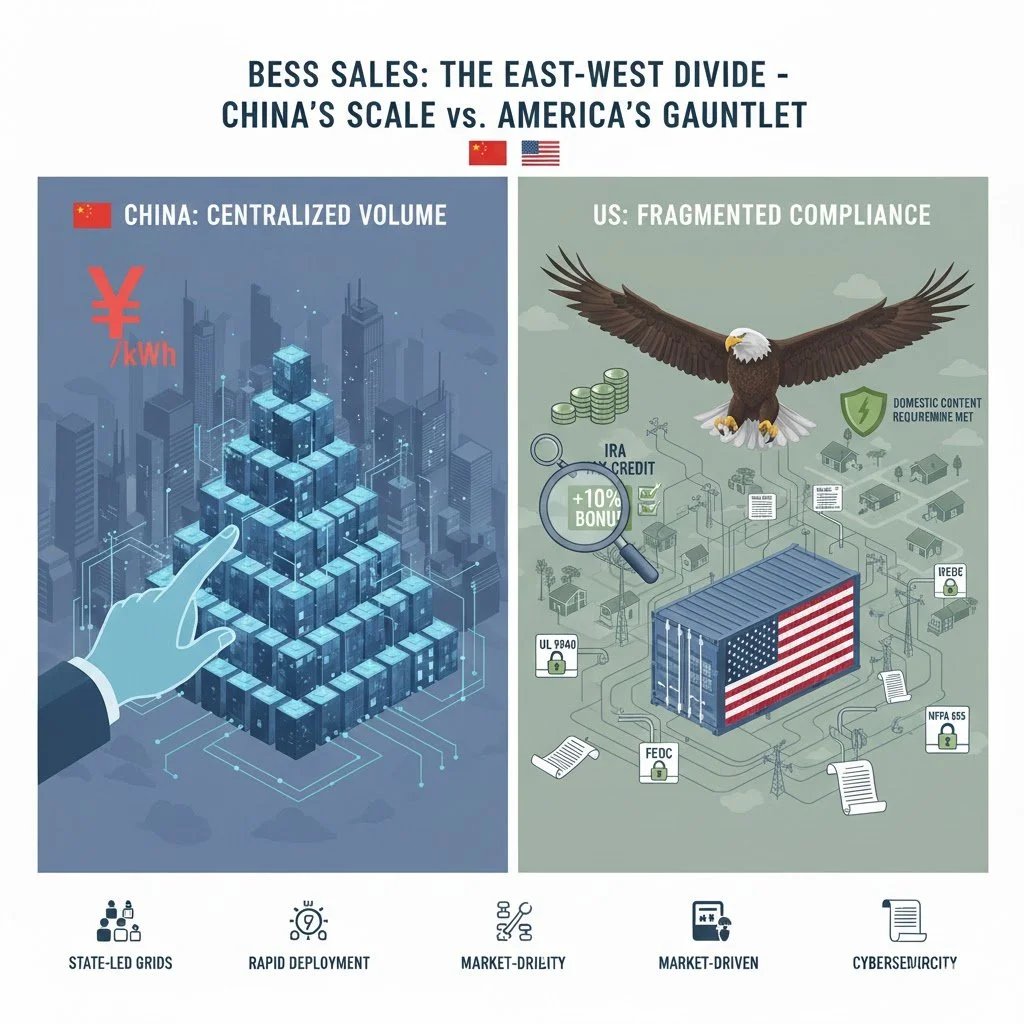
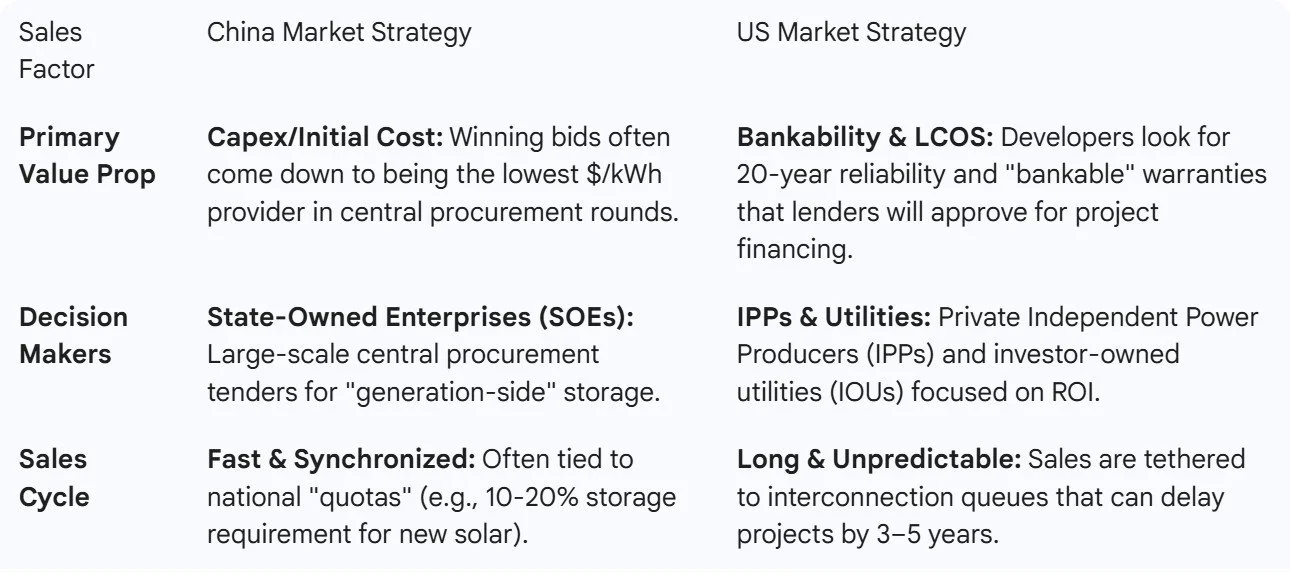
Selling a Battery Energy Storage System (BESS) in 2026 requires navigating two diametrically opposed sales environments. In China, the sales process is a volume-driven marathon of cost-efficiency and government alignment; in the US, it is a risk-mitigation steeplechase focused on bankability, regulatory compliance, and domestic protectionism.
1. The Sales Funnel: Scale vs. Bankability
2. Major Challenges Impacting US Sales for Chinese Integrators
As of 2026, the US sales environment has shifted from "open market" to "highly restricted," introducing three specific "deal-breaker" challenges for Chinese companies:
The "ITC Gap" & FEOC Rules: Under the One Big Beautiful Bill Act (OBBBA) and latest IRA updates, projects using components from "Foreign Entities of Concern" (FEOC) face total disqualification from the 30-50% Investment Tax Credit (ITC). For a salesperson, this means your product must be 30-50% cheaper than a domestic alternative just to reach price parity in the eyes of the developer.
The 10-Year Recapture Risk: A unique US sales challenge is "Recapture Risk." If a developer uses a Chinese integrator and the US government later determines the entity is a "prohibited foreign entity," the IRS can "claw back" the tax credits for up to 10 years. This makes many US lenders unwilling to finance projects using Chinese hardware.
Software "Air-Gapping": Sales are increasingly stalled by cybersecurity requirements. US utilities often demand that the Energy Management System (EMS) and all cloud-based monitoring be hosted on US-based servers (e.g., AWS GovCloud) and managed by US citizens to prevent "remote kill-switch" concerns.
3. Comparison of Selling Tactics
Selling in China: The "Centralized Volume" Model
Tactical Focus: Securing a spot on the "shortlist" for massive SOE tenders (e.g., State Grid or China Three Gorges).
Sales Lever: Leveraging vertical integration. If you make your own LFP cells, you use that margin to undercut competitors in the system integration bid.
Customer Relationship: Often involves "Regional Industrial Tie-ins"—where the integrator agrees to build a local assembly plant in a specific province in exchange for project awards.
Selling in the US: The "Consultative Risk" Model
Tactical Focus: Helping the developer navigate the "Internal Revenue Code." Your sales team must act as tax and regulatory consultants as much as engineers.
Sales Lever: "Safe Harbor" strategies. Sales teams often push to get 5% of project capex spent before tariff deadlines (like the Jan 1, 2026 hike) to lock in lower rates.
Customer Relationship: High-touch technical support. US customers expect local O&M (Operations & Maintenance) teams within 4 hours of the site. A "remote support from Shenzhen" model is a non-starter for utility-scale sales.
4. The 2026 "Price Floor" Disconnect
By early 2026, Chinese domestic prices have hit historic lows (approx. $60-$90/kWh for core equipment), while US "turnkey" prices for the same equipment can exceed $250/kWh due to stacked tariffs (Section 301, Anti-Dumping) and the loss of tax incentives. This means the salesperson is no longer selling "the same product at a different price," but rather selling a completely different financial structure.