Blog 3: Mobile Microgrid Market Requirements
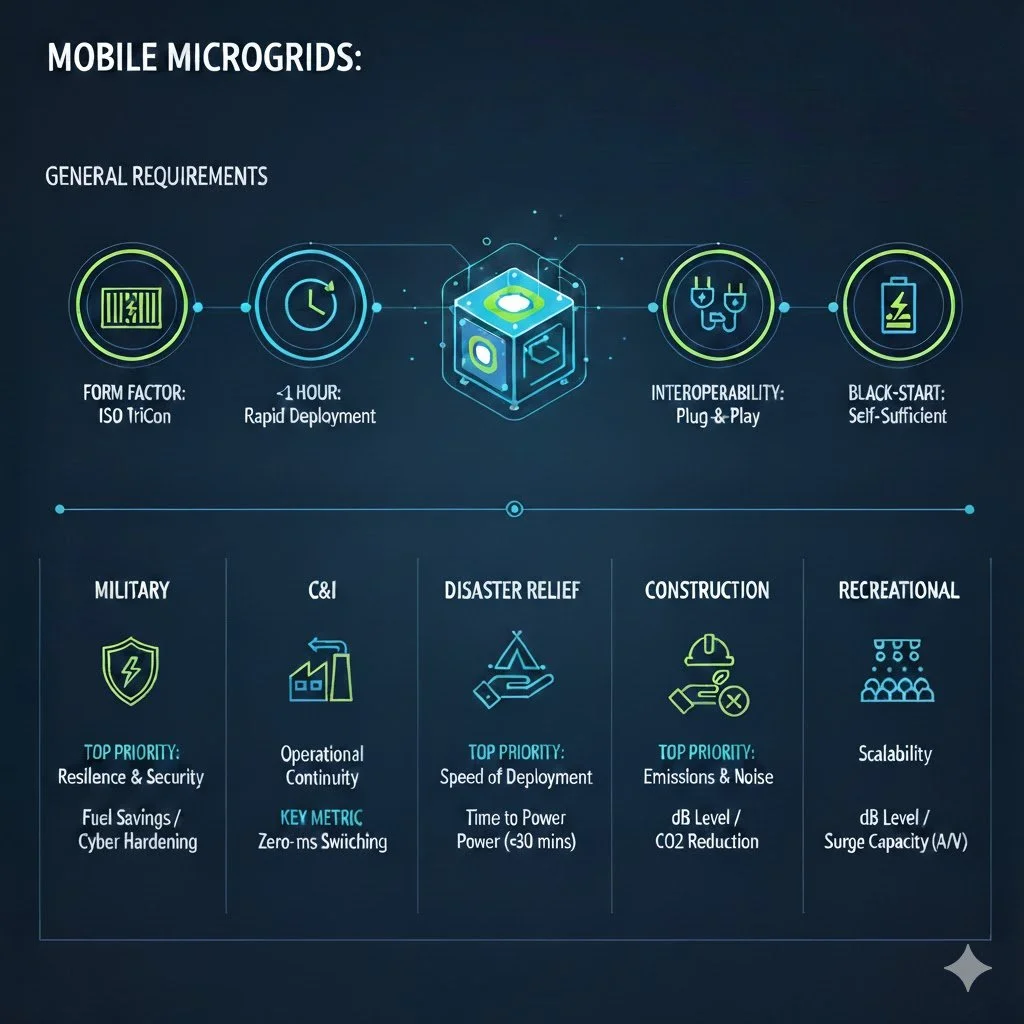
To address the requirements and needs for a mobile microgrid across these diverse markets, it is helpful to categorize them into operational requirements (how the system moves and starts) and functional needs (market-specific priorities).
General Technical Requirements
Across all sectors, "mobile" implies a specific set of engineering constraints that distinguish these units from stationary microgrids:
Form Factor: Must adhere to transport standards (e.g., ISO Triple Container/TriCon or "grid-on-a-skid" for flatbed trucks).
Rapid Deployment: Target setup times are often <1 hour with "plug-and-play" interfaces that do not require specialized engineering on-site.
Interoperability: Ability to "parallel" with existing assets (commercial-off-the-shelf generators, legacy solar arrays, or local utility taps).
Black-Start Capability: The system must be able to re-energize a local grid after a total blackout without external assistance.
Market-Specific Needs
1. Military (Forward Operating Bases & Expeditionary)
The military's primary driver is Energy Resilience and the "tether of fuel."
Cyber Hardening: Must meet strict MIL-STD-TMS (Tactical Microgrid Standard) to prevent non-kinetic attacks on power infrastructure.
Signature Reduction: Low thermal and acoustic signatures to avoid detection.
Fuel Efficiency: The goal is to reduce fuel consumption by 30–60% to minimize the number of high-risk fuel convoys.
Durability: Must withstand extreme environmental conditions (dust, heat, vibrations) during transport via C-17 or tactical vehicles.
2. Commercial & Industrial (C&I)
C&I users focus on Reliability and Uptime to protect revenue.
Seamless Transition: Must offer "hitless" islanding—switching from the macrogrid to the microgrid without a voltage dip that would reset industrial machinery or crash data centers.
Power Quality: High-fidelity regulation of voltage and frequency to protect sensitive electronic equipment.
Cost Management: Ability to perform peak shaving or demand response when connected to the grid to lower utility bills.
3. Disaster Relief
Speed and Versatility are the priorities for emergency responders.
Multifaceted Connectivity: Must be able to power diverse loads simultaneously, from oxygen concentrators in a field hospital to water pumps for a local community.
Multi-Input Flexibility: Ability to scavenge power from any available source (wind, solar trailers, or local hydro) as fuel supply chains may be broken.
Autonomous Operation: Smart controllers that prioritize "critical loads" (e.g., life support) over "non-critical loads" automatically.
4. Construction Sites
Needs are driven by Compliance and Operational Efficiency.
Silent Power: Often required for urban construction sites with noise ordinances during "unsociable hours."
Emission Reductions: Replacing diesel generators with battery-backed microgrids to meet local "green" site requirements.
Heavy Inrush Handling: Must be able to handle high surge currents from cranes or large power tools without tripping.
5. Recreational Venues (Festivals, Stadiums)
The focus here is Scalability and Experience.
Temporary Scalability: Needs to expand capacity for short-term "mega-events" where the permanent grid connection is insufficient.
Clean Energy Integration: High demand for "green events" where the microgrid must prominently feature and manage large solar/battery arrays.
Safety Standards: Compliance with NFPA 70 (NEC) and NFPA 855 for public-facing battery energy storage systems (BESS).