Blog 4: Why "Non-FEOC" is Now the Most Critical Spec Sheet in US Energy Storage
In 2026, sourcing batteries isn't just about energy density or cycle life. It’s about geopolitical compliance. Here is why the "Foreign Entity of Concern" rule has rewritten the playbook for US BESS finance.
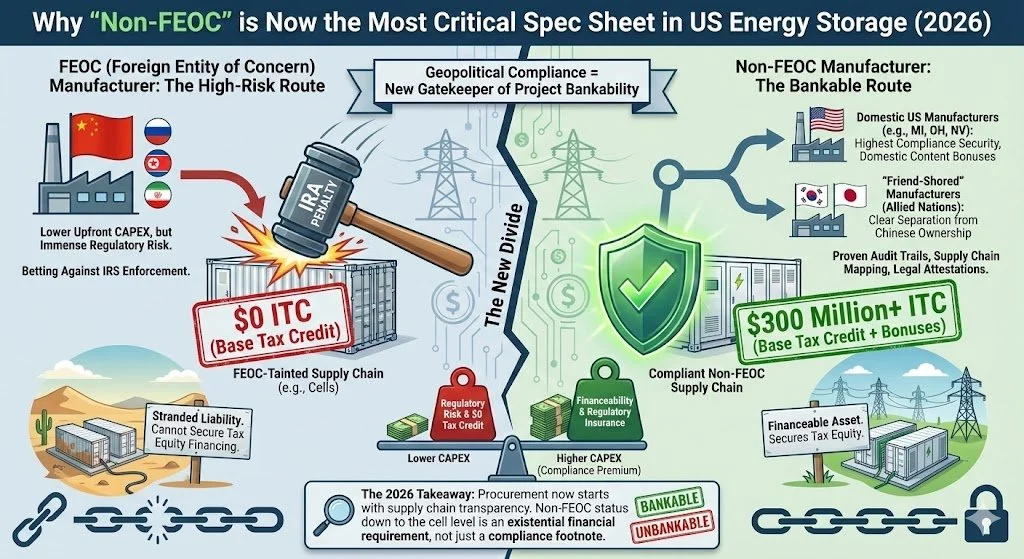
The US Battery Energy Storage System (BESS) market is firing on all cylinders. Grid demand is surging, data centers are hungry for backup power, and the project pipelines for 2026-2028 are massive.
But beneath the celebratory groundbreakings, a profound shift has occurred in how these projects are financed and procured. A single acronym—FEOC—has become the new gatekeeper of project bankability.
If you are a developer, investor, or procurement manager in the energy storage space, understanding the distinction between a "FEOC" and "Non-FEOC" manufacturer is no longer a compliance footnote. It is quite literally an existential financial requirement.
Here is a breakdown of the new reality of BESS supply chains.
What is a FEOC?
Foreign Entity of Concern (FEOC) is a designation defined by the US Department of Energy and reinforced by the Treasury Department under the Inflation Reduction Act (IRA).
In short, it refers to entities owned by, controlled by, or subject to the jurisdiction of specific foreign governments listed as geopolitical rivals to the United States. Currently, the primary nations on this list are China, Russia, North Korea, and Iran.
Given China’s historic dominance of the lithium-ion battery supply chain—controlling vast amounts of refining, cathode production, and cell manufacturing—this rule was designed specifically to reshape global energy supply lines.
The "Hammer" Drop: Why It Matters in 2026
For the first few years after the IRA passed, the conversation focused on the "carrots"—the bonus tax credits for using domestic content.
As of 2024 and fully realized now in 2026, the "sticks" have arrived.
The IRA includes a severe penalty for utilizing FEOC supply chains. If a BESS project utilizes battery components (like cells) manufactured or assembled by a FEOC, the project is ineligible for the base 30% Investment Tax Credit (ITC).
Let’s put that in perspective. On a standard 1GWh (1,000 MWh) utility-scale storage project valued at roughly $1 billion:
With Compliant (Non-FEOC) Cells: The project receives a $300 million tax credit base, plus potential bonuses.
With FEOC (e.g., certain Chinese) Cells: The project receives $0 in tax credits.
The stakes are absolute. A supply chain misstep doesn't just reduce your margins; it can turn a billion-dollar asset into a stranded liability that cannot secure tax equity financing.
The New Divide: FEOC vs. Non-FEOC Manufacturers
This regulatory reality has created a sharp bifurcation in the BESS manufacturing landscape.
1. The FEOC Manufacturer (The High-Risk Route)
These manufacturers may offer significantly lower upfront capital costs (CAPEX) due to established, scaled supply chains in China. However, their products carry immense regulatory risk for US deployment. Developers purchasing from these sources are essentially betting against IRS enforcement, a strategy few tax equity investors will tolerate in 2026.
2. The Non-FEOC Manufacturer (The Bankable Route)
These are the new kings of the US market. A "Non-FEOC" manufacturer is one that can prove, with robust audit trails, that their battery cells and critical supply chain steps occur outside of disqualified nations.
These manufacturers typically fall into two buckets:
Domestic US Manufacturers: Companies building cells and packs in places like Michigan, Ohio, or Nevada. They offer the highest compliance security and unlock Domestic Content bonuses.
"Friend-Shored" Manufacturers: Companies producing cells in allied nations like South Korea, Japan, or emerging hubs that have clear separation from Chinese ownership structures.
The Premium on Compliance
In 2026, we are seeing a distinct "compliance premium." Non-FEOC batteries are tighter in supply and cost more upfront than their FEOC counterparts.
However, smart money knows that "cheaper" cells are prohibitively expensive if they torch the 30% ITC.
A Non-FEOC manufacturer isn't just selling a battery; they are selling financeability and regulatory insurance. They provide the documentation—the supply chain mapping and the legal attestations—that tax equity partners demand before releasing funds.
The Takeaway for Developers
The era of simply buying the cheapest reliable LFP cell on the global market is over for US projects.
Every procurement discussion must now start with supply chain transparency. If a BESS supplier cannot definitively prove their Non-FEOC status down to the cell component level, they are not ready for the US market in 2026.
Due diligence is no longer just about technical performance; it’s about ensuring your project doesn’t fall victim to the most expensive acronym in energy.