Blog 6: From Concept to Kilowatt-Hour: A Deep Dive into the BESS Value Chain
The Battery Energy Storage System (BESS) market is exploding. Driven by the urgent need to stabilize grids saturated with renewable energy and fueled by massive legislative tailwinds like the Inflation Reduction Act (IRA), BESS is the critical infrastructure of the energy transition.
But a grid-scale battery isn't just a large box dropped into a field. Bringing a 100MWh project to life is a complex, multi-year relay race involving highly specialized stakeholders. A failure at any stage—from initial siting to final safety certification—can derail a billion-dollar investment.
This post breaks down the BESS value chain, detailing the specific responsibilities of each key player that turns a project concept into a reliable energy asset.
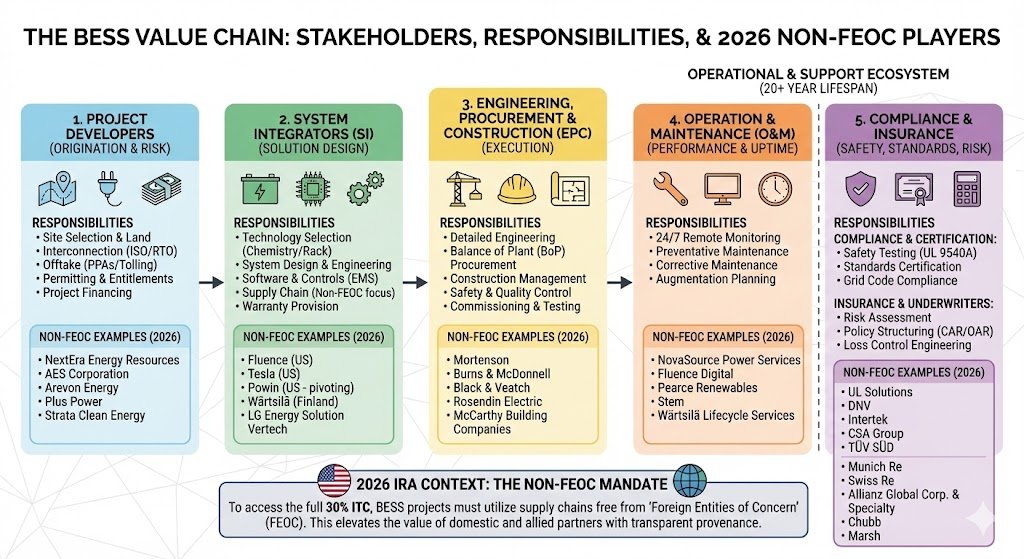
The Core Value Chain: The Relay Race
The creation of a BESS asset generally follows a linear progression, moving from ideation to design, and finally to construction.
(Graphic Placeholder: A horizontal flowchart showing arrows progressing from "Developer" -> "System Integrator" -> "EPC". Below this main flow, a foundational layer labeled "Support Ecosystem: O&M, Compliance, Insurance" spans the entire length.)
1. Project Developers (The Visionaries)
Developers are the originators of the project. They identify the opportunity and assume the highest initial risk. Their primary role is to package a viable business case that can attract financing.
Key Responsibilities:
Site Selection & Land Acquisition: Finding locations with grid needs and securing land rights.
Interconnection: Managing the complex, multi-year queue process to connect to the utility grid (ISO/RTO).
Offtake Agreements: Securing revenue streams, such as Power Purchase Agreements (PPAs) with utilities or tolling agreements.
Permitting & Entitlements: Navigating local, state, and federal environmental and zoning approvals.
Project Financing: Raising early-stage development capital and structuring debt/equity for construction.
2. System Integrators (The Architects)
The System Integrator (SI) sits between the component manufacturers and the project site. They don't just buy batteries; they design a complete technical solution that meets the developer's performance requirements.
Key Responsibilities:
Technology Selection: Choosing the right cell chemistry (e.g., LFP vs. NMC) and battery rack suppliers based on the use case (e.g., 2-hour vs. 4-hour duration).
System Design & Engineering: Integrating the DC battery blocks with the Power Conversion System (PCS/Inverter) and Thermal Management System (TMS).
Software & Controls (EMS): Developing the Energy Management System—the "brain" of the BESS that communicates with the grid operator and decides when to charge or discharge.
Supply Chain Management: Procuring critical components, increasingly with a focus on non-FEOC compliance to ensure tax credit eligibility.
Warranty Provision: Offering a performance wrap, guaranteeing capacity, round-trip efficiency, and availability for a set period (e.g., 10-20 years).
3. Engineering, Procurement & Construction - EPC (The Builders)
Once the project is developed and the system is designed, the EPC firm is hired to put steel in the ground. They are responsible for the physical realization of the asset on site.
Key Responsibilities:
Detailed Engineering: Creating final civil, structural, and electrical drawing sets for construction.
Balance of Plant (BoP) Procurement: Buying everything outside the main battery container—transformers, cabling, switchgear, and fencing.
Construction Management: hiring and managing local subcontractors for grading, foundations, and electrical installation.
Safety & Quality Control: Ensuring the site runs according to OSHA standards and the design specifications.
Commissioning: conducting the final on-site testing to prove the system works before handing the "keys" over to the owner.
The Operational & Support Ecosystem
Once the BESS is built, a new set of stakeholders takes over to ensure it operates safely, legally, and profitably for its 20-year lifespan.
(Graphic Placeholder: A circular diagram centering on an icon of an operating BESS asset. Three surrounding segments are labeled "O&M Monitors", "Certifiers & Auditors", and "Insurance Underwriters", with arrows indicating continuous feedback loops with the central asset.)
4. Operation & Maintenance - O&M (The Guardians)
BESS assets are not "set it and forget it." O&M providers ensure high availability and manage asset degradation over decades.
Key Responsibilities:
24/7 Remote Monitoring: Utilizing a Network Operations Center (NOC) to track alarms, temperatures, and performance data in real-time.
Preventative Maintenance: Scheduled site visits to inspect coolant levels, torque electrical connections, and clean filters.
Corrective Maintenance: Rapid response to fix inverter faults, replace faulty battery modules, or repair balance-of-plant equipment.
Augmentation Planning: Developing strategies to add new batteries over time to combat natural capacity degradation.
5. Compliance & Certification (The Gatekeepers)
This sector ensures the technology is safe and meets rigorous industry standards. Without their stamp of approval, a project cannot interconnect or get insured.
Key Responsibilities:
Safety Testing: Conducting destructive tests (like UL 9540A thermal runaway propagation tests) at the cell, module, and unit levels.
Standards Certification: Certifying that the integrated system meets national standards like UL 9540 and NFPA 855 (fire codes).
Grid Code Compliance: Verifying that the BESS inverter settings meet the specific requirements of the local grid operator (e.g., IEEE 1547).
6. Insurance & Underwriters (The Risk Mitigators)
BESS projects are high-value assets with perceived fire and technology risks. Underwriters evaluate these risks to provide the policies necessary for financing.
Key Responsibilities:
Risk Assessment: Evaluating the technology tier, the quality of the EPC, the robustness of the O&M plan, and the results of safety testing (UL 9540A).
Policy Structuring: Providing comprehensive coverage including Construction All Risk (CAR), Operational All Risk (OAR), general liability, and sometimes performance warranty insurance.
Loss Control Engineering: Advancing best practices for site layout and fire suppression to minimize potential losses.
The 2026 Context: The Non-FEOC Rolodex
As of 2026, the Inflation Reduction Act (IRA) has made supply chain provenance a dominant factor. To access the full 30% Investment Tax Credit, projects must avoid using components from "Foreign Entities of Concern" (FEOC). This has elevated the importance of companies with clean, transparent, and often domestic or allied-nation supply chains.
Below is a list of major players in each segment of the value chain that are generally recognized as non-FEOC compliant entities in the 2026 US market.
The Non-FEOC Value Chain List (5x5)
Value Chain Segment5 Key Non-FEOC (US/Allied) Players
1. Project Developers
NextEra Energy Resources
AES Corporation
Arevon Energy
Plus Power
Strata Clean Energy
2. System Integrators
Fluence (US)
Tesla (US)
Powin (Bankrupt)
Wärtsilä (Finland)
LG Energy Solution Vertech (South Korea/US)
3. EPC Firms
Mortenson
Burns & McDonnell
Black & Veatch
Rosendin Electric
McCarthy Building Companies
4. O&M Providers
NovaSource Power Services
Fluence Digital
Pearce Renewables
Stem (Software/Asset Management)
Wärtsilä Lifecycle Services
5. Compliance & Certification
UL Solutions
DNV
Intertek
CSA Group
TÜV SÜD
6. Insurance & Underwriters
Munich Re
Swiss Re
Allianz Global Corporate & Specialty
Chubb
Marsh (Major Broker)