Blog 7: Mastering the BESS Value Chain: A Guide to Request for Proposals (RFPs) for Every Stakeholder
The Battery Energy Storage System (BESS) market is maturing rapidly, moving from pilot projects to large-scale infrastructure assets. In this high-stakes environment, the success of a project hinges on selecting the right partners at every stage. The primary tool for this strategic sourcing is the Request for Proposal (RFP).
An RFP is more than just a procurement document; it’s a strategic instrument that defines project scope, sets performance expectations, and ultimately determines the bankability of a BESS asset. However, what an RFP means—and what it should contain—varies significantly depending on where you sit in the value chain.
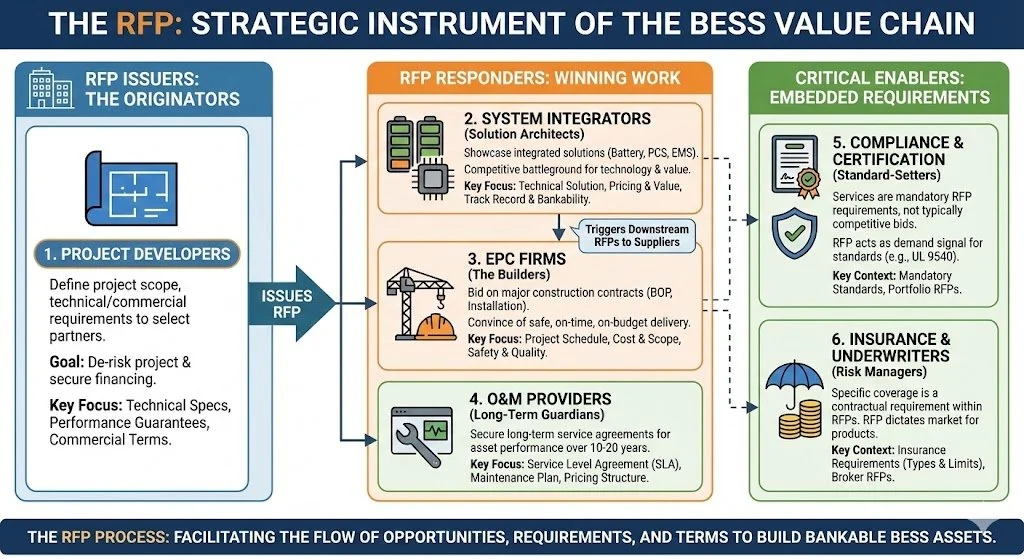
Here is a detailed look at what RFPs mean for each key stakeholder in the BESS industry.
1. Project Developers: The Originators & Orchestrators
For project developers, the RFP is the primary mechanism for turning a project concept into a reality. Developers are typically the issuers of RFPs, using them to create a competitive process to select the best technology, construction, and service partners. A well-structured RFP is crucial for de-risking a project and securing financing.
What RFPs Mean for Them: It's about defining the project's technical and commercial requirements in clear terms to attract high-quality bids. The goal is to balance cost competitiveness with technical reliability and performance guarantees. A poorly written RFP can lead to ambiguous bids, project delays, and cost overruns.
Key RFP Considerations:
Technical Specifications: clearly defining use cases (e.g., frequency regulation, energy shifting), required capacity (MW) and duration (MWh), round-trip efficiency, and lifespan.
Performance Guarantees: requiring robust warranties for capacity degradation, availability, and efficiency over the project’s life.
Commercial Terms: defining payment milestones, liquidated damages for delays, and long-term service agreement structures.
2. System Integrators: The Solution Architects
System integrators are the primary responders to RFPs issued by developers for the supply of the BESS itself. For them, an RFP is a critical sales opportunity. Their response must demonstrate not only technical compliance but also the superior value of their integrated solution, which includes batteries, power conversion systems (PCS), and energy management software (EMS).
What RFPs Mean for Them: An RFP is a competitive battleground to showcase their technology's performance, reliability, and total cost of ownership. It’s also a trigger for their own procurement, as they may issue downstream RFPs to component suppliers for cells, inverters, and other hardware.
Key RFP Response Focus:
Technical Solution: providing a detailed design that meets or exceeds the developer's specifications, highlighting unique features of their EMS or safety systems.
Pricing & Value: offering a competitive capital cost (CAPEX) while demonstrating lower operating costs (OPEX) through superior efficiency or lower degradation.
Track Record & Bankability: providing evidence of successful past projects and the financial strength to back long-term warranties.
3. Engineering, Procurement & Construction (EPC) Firms: The Builders
EPC firms respond to RFPs from developers for the balance-of-plant (BOP) and installation scope. This includes everything outside the core BESS container, such as site preparation, foundations, electrical cabling, transformers, and grid interconnection.
What RFPs Mean for Them: An RFP is an invitation to bid on a major construction contract. Their response needs to convince the developer that they can build the project safely, on time, and within budget, while managing the complex logistics of a large-scale site.
Key RFP Response Focus:
Project Schedule: proposing a realistic and detailed timeline for design, procurement, construction, and commissioning.
Cost & Scope: providing a fixed-price or guaranteed maximum price bid based on a clear delineation of scope boundaries with the system integrator.
Safety & Quality: demonstrating a strong safety record and quality control plan for site works.
4. Operation & Maintenance (O&M) Providers: The Long-Term Guardians
O&M providers respond to RFPs for long-term service agreements, which are often part of the initial project procurement or issued separately as the project nears completion. For them, an RFP is a chance to secure a long-term, recurring revenue stream.
What RFPs Mean for Them: The RFP is about defining the service levels required to keep the BESS asset performing optimally for 10, 15, or 20 years. Their response must show how they will meet availability guarantees and manage preventative and corrective maintenance.
Key RFP Response Focus:
Service Level Agreement (SLA): defining guaranteed response times for faults and overall system availability targets.
Maintenance Plan: outlining a comprehensive plan for scheduled maintenance, spare parts management, and remote monitoring.
Pricing Structure: proposing a clear fee structure, often a fixed annual fee with variable costs for major repairs or augmentations.
5. Compliance & Certification Bodies: The Standard-Setters
Unlike other stakeholders, compliance and certification bodies don't typically win work through competitive RFPs for individual projects. Instead, their services are a mandatory requirement embedded within the RFPs issued by developers.
What RFPs Mean for Them: RFPs act as a demand signal for their services. When a developer's RFP states that a BESS must be certified to standards like UL 9540 or IEC 62933, it creates a non-negotiable requirement for the system integrator to engage a certification body.
Key RFP Context:
Mandatory Standards: Developers specify the exact safety, performance, and grid codes that the project must comply with.
Portfolio RFPs: Large developers with a pipeline of projects might issue an RFP to select a single certification partner to provide testing and certification services across their entire portfolio, ensuring consistency and potentially securing volume pricing.
6. Insurance & Underwriters: The Risk Managers
Similar to compliance bodies, insurers don't respond to project RFPs in the traditional sense. Instead, the need for specific insurance coverage is a standard contractual requirement within RFPs and agreements between developers, contractors, and suppliers.
What RFPs Mean for Them: The insurance requirements specified in project RFPs dictated the market for their products. For example, a developer's RFP to an EPC will require them to carry specific levels of general liability, professional liability, and builder's risk insurance.
Key RFP Context:
Insurance Requirements: RFPs specify the types and minimum limits of insurance coverage that each party must maintain.
Broker RFPs: A developer or asset owner might issue an RFP to insurance brokers to find the best partner to structure and place a comprehensive insurance program for a large project or a fleet of assets, seeking the best coverage terms and pricing from the underwriting market.
In conclusion, the RFP process is the circulatory system of the BESS industry, facilitating the flow of project opportunities, technical requirements, and commercial terms between stakeholders. For developers, it's a tool for control and selection. For integrators, EPCs, and O&M providers, it's the gateway to new business. And for compliance and insurance bodies, it sets the mandatory baseline for market participation. Understanding the nuances of the RFP from each perspective is essential for navigating the complex and competitive world of energy storage.